

Life Science Tools Market to reach USD 332.00 Billion by 2035 at 7.35% CAGR
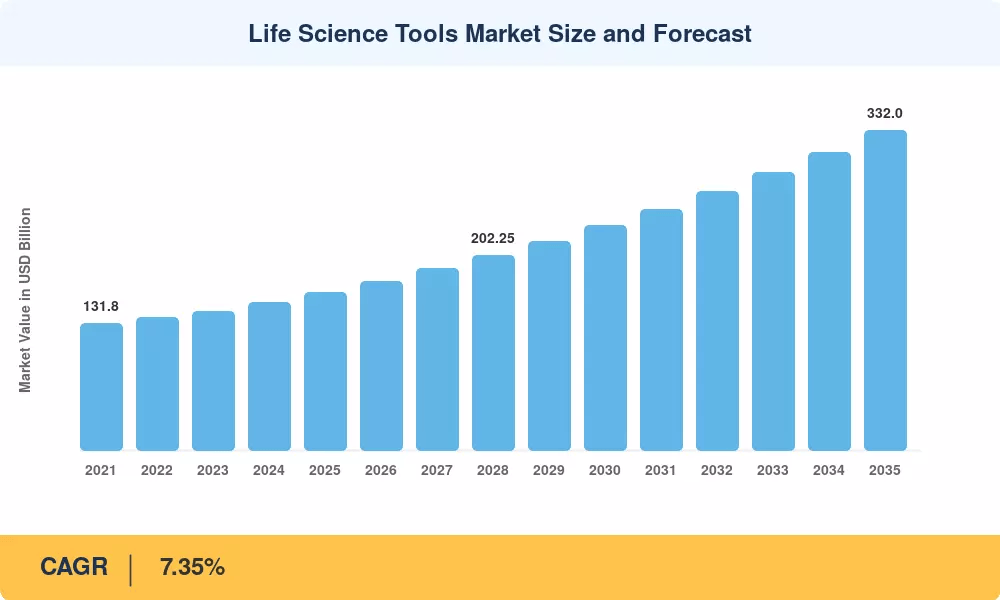
Life science tools market Size
Life Science Tools Market to Surge from USD 175.50B in 2026 to USD 332.00B by 2035---Powered by Government Biotech Funding Packages, AI-Driven Lab Automation
NY, CA, UNITED STATES, June 30, 2026 /EINPresswire.com/ -- As per Market Research Future, the global Life Science Tools Market size to reach USD 332.00 Billion by 2035 from USD 175.50 Billion in 2026, at a CAGR of 7.35% during the forecast period 2026--2035. The market base was estimated at USD 163.50 Billion in 2025.The 7.35% CAGR---anchored by structural R&D demand rather than discretionary healthcare spending---is driven by three converging forces: government-led funding packages---including a proposed USD 88 billion biotechnology allocation by the United States Congress for 2025---channeling fresh capital into validated instruments, sequencing platforms, and compliance-ready consumables; falling per-genome sequencing costs that have dropped to USD 200, shifting next-generation sequencing from large academic centers into community hospitals and mid-tier diagnostic chains; and the technological shift from manual bench operations toward automated high-throughput platforms combining robots, microfluidics, and AI-driven data interpretation that reduce sample-preparation errors by an estimated 35--40%.
National governments and multilateral research organizations are amplifying this momentum. The proposed USD 88 billion U.S. biotechnology package earmarks substantial allocations for automated sequencing centers, biosafety-level-3 laboratory upgrades, and biomanufacturing pilot facilities. Horizon Europe's Cluster 1---Health---disbursed EUR 8.2 billion through 2024 and has committed additional tranches through 2027, underwriting mass spectrometry, flow cytometry, and imaging-system procurements across 27 member states.
Request A Free Sample:
https://www.marketresearchfuture.com/sample_request/12273
Key Market Trends & Growth Drivers
Government Biotech Funding Packages and Federal Research Infrastructure Investment
Public-sector investment remains the single most powerful catalyst for the life science tools market. The proposed USD 88 billion U.S. biotechnology package earmarks substantial allocations for automated sequencing centers, biosafety-level-3 laboratory upgrades, and biomanufacturing pilot facilities. In parallel, Horizon Europe's Cluster 1 ---Health---disbursed EUR 8.2 billion through 2024 and has committed additional tranches through 2027, underwriting mass spectrometry, flow cytometry, and imaging-system procurements across 27 member states. The NIH sustains appropriations exceeding USD 47 billion annually, creating recurring demand for high-throughput sequencing and mass spectrometry systems. Canada's Genomics Canada initiative has committed CAD 1.2 billion through 2028. France 2030 has allocated EUR 7 billion to health-innovation infrastructure. Each funding cycle translates into measurable procurement volume, and the embedded multi-year grant structure makes this driver structurally durable through 2035.
Falling Sequencing Costs and Clinical Adoption of Next-Generation Sequencing
Per-genome costs have declined from approximately USD 600 in 2020 to under USD 200 by late 2024, a trajectory that has shifted next-generation sequencing from large academic centers into community oncology practices and neonatal screening programs. This price democratization is expanding the addressable market for reagent kits, library-preparation consumables, and bioinformatics software, directly amplifying recurring-revenue streams for the life science tools market. Clinical-grade whole-genome sequencing adoption and expanding newborn-screening mandates in North America and Europe are driving instrument upgrades. The use of multi-omics---the combination of genomic, proteomic, and metabolomic readouts in a single pipeline---is driving higher equipment refresh rates, particularly in academic medical institutes that receive grants from the NIH and Horizon Europe. Next-generation sequencing is the fastest-growing technology segment at 18.2% CAGR, fueled by falling per-genome costs and broadening clinical utility.
AI-Driven Lab Automation and Robotics Reshaping Research Operations
Robotic liquid-handling systems paired with machine-learning quality-control algorithms are reducing sample-preparation errors by an estimated 35--40% in high-throughput screening environments. Major pharmaceutical companies have committed over USD 4 billion collectively to automated discovery labs between 2023 and 2025, creating pull-through demand for integrated instrument--software bundles across the life science tools market. Automated high-throughput platforms combining robots, microfluidics, and artificial intelligence--driven data interpretation are replacing manual bench operations. By 2030, an estimated 45% of new mass spectrometry and flow cytometry installations will embed on-board machine-learning modules that autonomously optimize acquisition parameters, reducing operator dependency and increasing throughput by 25--30%. This convergence will reshape competitive dynamics across the life science tools market as software differentiation eclipses hardware specification.
Ask for Customization:
https://www.marketresearchfuture.com/ask_for_customize/12273
Market Segment Insights
BY PRODUCT
Instruments: Dominant segment with 46.5% revenue share in 2025. Reflecting strong demand for next-generation sequencing and mass spectrometry platforms. Driven by capital-equipment refresh cycles at major academic and pharmaceutical campuses. Instruments anchor the life science tools market by value, as sequencing system upgrades and mass spectrometry replacements create large-ticket procurement events.
Consumables: USD 62.80 Billion in 2025. Generate the most predictable recurring revenue, as reagent kits and sample-preparation supplies are replenished with every experiment. The non-discretionary nature of consumable purchases makes this segment structurally resilient through economic cycles.
BY TECHNOLOGY
PCR & qPCR: Dominant technology with 24.2% share in 2025. Sustained by infectious-disease surveillance and molecular diagnostics. Underpinned by pandemic-era infrastructure investments that have been repurposed for endemic respiratory surveillance and oncology liquid-biopsy workflows. Hospital formulary committees default to PCR systems for inpatient diagnostic protocols, and this institutional inertia sustains the segment's majority share.
Next-Generation Sequencing: Fastest-growing technology segment at 18.2% CAGR (2026--2035). Fueled by falling per-genome costs and broadening clinical utility. Clinical-grade whole-genome sequencing adoption and expanding newborn-screening mandates in North America and Europe are driving instrument upgrades. The shift from outsourced reference-lab testing to in-house sequencing capabilities is expanding the addressable base for sequencing platforms and library-prep consumables.
BY APPLICATION
Genomic Technology: Dominant application with 35.4% share in 2025. Reflecting the maturity of sequencing-based clinical workflows and the scale of government-funded population-genomics programs. Precision oncology and pharmacogenomics applications continue to expand the addressable base.
Proteomics Technology: Fastest-growing application segment at 14.1% CAGR (2026--2035). As drug developers increasingly adopt mass spectrometry--based biomarker discovery and drug-target validation. Mass spectrometry sensitivity improvements and data-independent acquisition methods enable deeper proteome coverage, attracting pharmaceutical R&D investment.
BY END USER
Research Laboratories: Dominant end-user segment with 62.0% share in 2025. Supported by long-term government grant cycles and pharmaceutical discovery pipelines. Academic medical institutes receiving NIH and Horizon Europe grants drive instrument procurement at scale.
Diagnostic Laboratories: Fastest-growing end-user segment at 12.75% CAGR (2026--2035). Propelled by FDA LDT regulation and point-of-care testing expansion. The phased premarket-review requirement compels diagnostic laboratories to adopt validated, manufacturer-supported assay kits over in-house tests, shifting purchasing toward established vendors with FDA-cleared platforms.
Read Detailed Insights:
https://www.marketresearchfuture.com/reports/life-science-tools-market-12273
Regional Outlook
North America --- Dominant Market (~40.5% Share, 2025)
The United States generates approximately 82.3% of North American Life Science Tools Market revenue, driven by sustained NIH appropriations exceeding USD 47 billion annually and a large installed base of high-throughput sequencing and mass spectrometry systems. The proposed USD 88 billion biotechnology package earmarks substantial allocations for automated sequencing centers and biomanufacturing pilot facilities. Canada contributes through Genomics Canada investment pipeline at approximately 7.85% CAGR. Mexico contributes USD 1.95 Billion in 2025 on medical-device nearshoring trends as multinational OEMs establish regional assembly and calibration facilities. North America's leadership rests on federal research support depth and the structural R&D segment created by expanded NIH budgets and precision-medicine mandates.
Europe --- Second Largest (USD 45.45 Billion, 2025)
Europe's Life Science Tools Market reflects harmonized EU regulatory frameworks and substantial public research funding. Germany leads regionally with Fraunhofer and Max Planck institute networks at approximately 23.5% of regional share, serving as anchor customers for advanced imaging and separation-technology platforms. The United Kingdom contributes at approximately 7.60% CAGR on UK Biobank and NHS genomic-medicine program demand. France contributes USD 5.80 Billion through France 2030 biotech plan. Italy is growing at approximately 6.90% CAGR on pharmaceutical export base demand. Spain contributes USD 3.15 Billion on EU cohesion fund lab upgrades. The Nordic countries are growing at approximately 7.25% CAGR on biobank registries and precision oncology leadership. Russia contributes USD 2.10 Billion on import-substitution mandates. The rest of Europe is growing at approximately 6.50% CAGR on academic research expansion. Harmonization pressure from Horizon Europe funding and EU genomic-medicine programs is gradually lifting baseline demand across the region.
Asia-Pacific --- Fastest-Growing Region (11.75% CAGR, 2026--2035)
Asia-Pacific is the engine of the Life Science Tools Market. China holds the largest regional share at approximately 42.8%, with the 14th Five-Year Plan prioritizing biotechnology as a cornerstone of national innovation and driving massive investment into bio-manufacturing and innovation zones in Shanghai, Beijing, and Shenzhen. India is growing at approximately 13.40% CAGR on PLI scheme incentives and diagnostic-lab expansion---the diagnostic laboratory count has expanded by over 18% annually since 2022, generating strong pull-through demand for PCR systems and automated sample-processing lines. Japan contributes USD 6.25 Billion through regenerative-medicine R&D. South Korea is growing at approximately 10.80% CAGR on Bio-Health Industry Strategy. ASEAN economies contribute USD 3.10 Billion on public-health sequencing programs. The rest of Asia-Pacific is growing at approximately 9.50% CAGR on university research build-out. The region's combined biotech park expansion and PLI schemes anchor the global volume base for instrument and consumable demand.
Middle East & Africa --- Emerging Opportunity (8.65% CAGR, 2026--2035)
The Middle East & Africa carries significant infrastructure gaps and therefore opportunity. Saudi Arabia leads the region with Vision 2030 health-sector investment, contributing approximately 28.5% of regional share---over USD 5 billion channelled into health-research infrastructure, including three new national reference laboratories equipped with advanced sequencing and proteomics platforms. The UAE is growing at approximately 9.80% CAGR on Dubai Science Park and Abu Dhabi hub positioning. South Africa contributes USD 1.05 Billion on National Health Laboratory Service modernization. Egypt is growing at approximately 7.90% CAGR on pharmaceutical manufacturing expansion. The rest of MEA is growing on WHO-supported diagnostic rollout at USD 1.60 Billion. Gulf Cooperation Council states are investing heavily in health-research infrastructure as part of economic diversification agendas, creating new greenfield demand for sequencing and proteomics platforms across the Life Science Tools Market.
South America --- Growing Presence (USD 8.50 Billion, 2025)
Brazil anchors South America's Life Science Tools Market at approximately 58.5% of regional revenue, with Sistema Único de Saúde (SUS) expanding genomic-testing coverage to eight additional rare-disease categories since 2023, directly increasing demand for sequencing reagent kits and bioinformatics services. Argentina is growing at approximately 8.10% CAGR on agricultural genomics crossover demand. The rest of South America is growing on Pan-American Health Organization procurement at USD 1.85 Billion in 2025. South America's procurement runs largely through public-health sequencing programs and agricultural research networks, which pool demand to secure competitive pricing. The region's stable demand base supports manufacturer volume planning even as per-unit tender prices compress margins.
Competitive Landscape and Recent Developments
The Life Science Tools Market is moderately concentrated, with the combined market share of the top five firms estimated at 45--52% of global revenues. The Herfindahl--Hirschman Index is in the 800--1,200 range, reflecting a moderately competitive structure where scale efficiencies in reagent manufacture and service networks provide considerable obstacles to entry, yet allow specialty innovators to capture niche markets. Concentration is highest in high-income segments where regulatory and capital barriers are steep; the emerging-market tier is more fragmented as regional distributors compete on price and localized service.
The competitive landscape is stratified between full-stack portfolio leaders serving enterprise research contracts, specialized technology providers capturing niche analytical applications, and consumables specialists anchoring recurring revenue through reagent and kit supply.
KEY COMPANIES AND RECENT MILESTONES
Thermo Fisher Scientific (2024--2025): Maintains leadership with sequencers, mass spectrometers, and reagent kits, commanding approximately 14--18% of global Life Science Tools Market revenue. Full-stack portfolio leader with vertically integrated manufacturing from instruments to consumables to software.
Danaher Corporation (December 2023): Completed the USD 5.7 billion acquisition of Abcam, integrating antibody and protein-reagent portfolios into its Cytiva and Beckman Coulter Life Sciences divisions. Estimated revenue share: approximately 10--14%. M&A-driven platform strategy consolidating flow cytometry, chromatography, and bioprocessing capabilities.
Agilent Technologies (April 2024): Opened a USD 725 million manufacturing campus in Colorado to expand production of liquid chromatography columns and mass spectrometry components. Estimated revenue share: approximately 6--9%. Precision-medicine and pharma QA focus.
Merck KGaA (MilliporeSigma) (November 2023): Invested EUR 300 million in a new filtration and chromatography-media facility in Ireland to support biopharma customers and reduce supply-chain single-source risk. Estimated revenue share: approximately 5--8%. Consumables depth anchoring biopharma workflow integration.
Illumina (2024--2025): NGS platforms, library-prep kits, and informatics anchor sequencing market share leadership. Estimated revenue share: approximately 5--7%.
Bio-Rad Laboratories (2024--2025): PCR systems, electrophoresis, and quality controls anchor academic and clinical PCR stronghold positioning. Estimated revenue share: approximately 3--5%.
Waters Corporation (2024--2025): UPLC, mass spectrometry, and informatics anchor chromatography and pharma compliance positioning. Estimated revenue share: approximately 3--5%.
Bruker Corporation (2024--2025): NMR, MALDI-TOF, and X-ray systems anchor high-resolution analytical instruments positioning. Estimated revenue share: approximately 2--4%.
Future Outlook: 2026--2035
By 2030, AI-integrated instrumentation will become the operating system of laboratory operations. An estimated 45% of new mass spectrometry and flow cytometry installations will embed on-board machine-learning modules that autonomously optimize acquisition parameters, reducing operator dependency and increasing throughput by 25--30%. This convergence will reshape competitive dynamics across the life science tools market as software differentiation eclipses hardware specification. Real-world evidence frameworks are evolving to enable label expansions and support payer negotiations without new prospective trials, creating a new business model layered on top of the core instrument franchise.
Platform-as-a-service economics will reframe procurement models by the early 2030s. The shift from capital expenditure to operating expenditure procurement models is accelerating. Vendors offering instrument-plus-consumable-plus-analytics subscriptions can stabilize revenue visibility while lowering adoption barriers for budget-constrained laboratories in emerging markets. By 2033, platform-as-a-service contracts are forecast to represent roughly 30% of total revenues in the life science tools market. Subscription models bundle maintenance, calibration, and software upgrades into fixed monthly fees, often reducing five-year total cost by 15--20% for mid-sized laboratories. As per-device costs fall with scale, the addressable channel widens from centralized research institutes to decentralized diagnostic clinics and point-of-care settings, extending life science tools beyond traditional laboratory walls.
Sustainability and green laboratory initiatives will reshape vendor selection criteria. The My Green Lab certification program has been adopted by over 1,500 facilities globally, pushing instrument manufacturers to reduce solvent consumption, energy draw, and single-use plastics. Regulatory pressure from the EU's Corporate Sustainability Reporting Directive will require vendors selling into European institutions to disclose Scope 3 emissions, adding a sustainability dimension to procurement decisions. Companies that achieve 20--30% material weight reduction and energy efficiency improvements without compromising analytical performance will capture procurement preference in markets where ESG scoring influences institutional purchasing.
Decentralized and point-of-care expansion will reshape supply geography. Portable sequencing devices and handheld PCR systems are migrating laboratory-grade analysis to field clinics, veterinary stations, and agricultural testing sites. The WHO's expanded Essential Diagnostics List and Africa CDC's Pathogen Genomics Initiative are jointly catalyzing procurement of compact instruments that extend the life science tools market beyond traditional laboratory walls. Localization will reduce import dependence and reshape tender dynamics. The next decade will see market consolidation around platform companies that aggregate instrument registry, consumable supply, and analytics datasets at scale---creating recurring-revenue streams that mirror SaaS economics. WHO's Essential Diagnostics List expansion and the Africa CDC's Pathogen Genomics Initiative underscore that health equity and commercial expansion are now aligned forces driving the Life Science Tools Market to its USD 332.00 Billion 2035 destination.
Larry Wilson
WantStats Research And Media Pvt. Ltd.
+1 855-661-4441
email us here
Visit us on social media:
LinkedIn
Facebook
YouTube
X
Legal Disclaimer:
EIN Presswire provides this news content "as is" without warranty of any kind. We do not accept any responsibility or liability for the accuracy, content, images, videos, licenses, completeness, legality, or reliability of the information contained in this article. If you have any complaints or copyright issues related to this article, kindly contact the author above.
